 NHM Mizoram
National Vector Borne Diseases Control Programme (NVBDCP)
INTRODUCTION:
The Malaria Control Programme was launched in Mizoram in 2005, while the Dengue Control Programme was initiated during 2012–2013. Significant progress has been made in combating these diseases over the past decades; however, much work remains if we are to achieve complete elimination of malaria. Among the six vector-borne diseases, malaria continues to pose a major public health challenge in the State.
In recent years, the incidence of Dengue and Chikungunya has been rising steadily, with a few fatal cases of dengue reported. Apart from indigenous malaria cases, Dengue, Chikungunya, and Japanese Encephalitis (JE) present emerging threats to the State. The widespread presence of Culex mosquitoes makes the occurrence of Acute Encephalitis Syndrome (AES) and JE a real possibility, as suspected cases have already been reported, including one laboratory-confirmed case of JE in 2022. On the other hand, Kala-azar and Lymphatic Filariasis have not been detected in Mizoram so far.
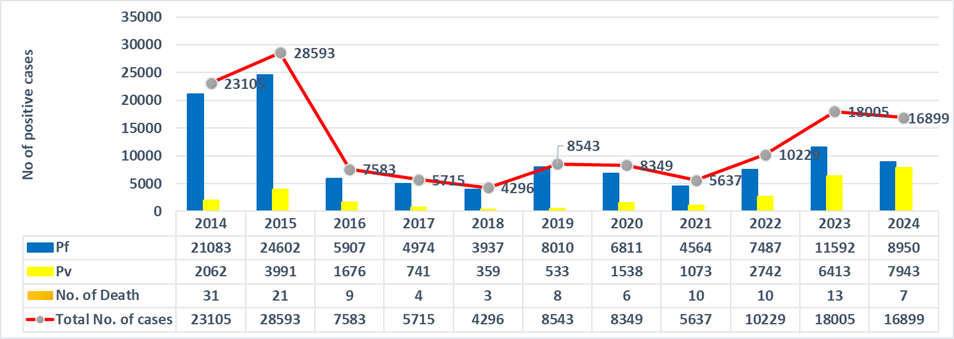
Although the incidence and mortality from indigenous malaria had been on a declining trend over the past three to four years, the situation reversed in 2021–2022, when there was a sharp rise in positive cases and a slight increase in deaths. This resurgence was partly attributed to scanty, intermittent rainfall combined with a persistently warm and humid climate, as well as an influx of refugees from neighbouring countries. Malaria cases rose across the State, affecting both low-endemic and high-endemic districts, with several reports of focal outbreaks in the latter.
Fortunately, the combined efforts of the District and State authorities, with strong support and guidance from the Directorate of NVBDCP, New Delhi, helped to bring the situation under control and prevent further mortality.
The State Vector Borne Disease Control Programme (SVBDCP), Mizoram, expresses its gratitude to the Central Government for consistently extending financial, material and HR support in the fight against vector-borne diseases, particularly malaria. The Programme reiterates its commitment to continue working tirelessly towards reducing the burden of these dreadful diseases, thereby safeguarding public health and contributing to the State’s social and economic development.
Malaria Control activities in India
• Prior to 1953: Estimated malaria case in India – 75 millions; deaths –0.8 million
• 1953 – National Malaria Control Programme (NMCP)
• 1958: National Malaria Eradication Programme
• 1965: Cases reduced to 0.1 million
• Early 1970s : Resurgence of malaria
• 1976: Malaria cases - 6.46 millions
• 1977: Modified Plan of Operation (MPO)
• 1977: World Bank assisted Enhanced Malaria Control Project
• 1999: National Anti-Malarial Programme (NAMP)
• 2002 : National Vector Borne Diseases Control Programme (NVBDCP)
• Six Vector Borne Diseases - Malaria, Filariasis, Kala-Azar, Dengue, Japanese Encephalitis (JE) & Chikungunya.
• 2005: Global Fund assisted Intensified Malaria Control Project (IMCP)
• 2005: State Vector Borne Diseases Control Programme (SVBDCP) (Mizoram) – Malaria only
• 2006: ACT introduced in areas showing Chloroquine resistance Pf
• 2008: ACT extended to high Pf predominant districts
• 2009: Introduction of LLINs
• 2012: SVBDCP (Mizoram) - Dengue & Chikungunya added
National Strategic Plan 2023-2030
1. Vision: Malaria Free India
2. Mission: Malaria elimination in India by 2030 aligned with the Global Technical Strategy 2016-30 and National Framework for Malaria Elimination 2016-30.
3. Goals:
i. Interrupt local transmission and achieve zero indigenous case throughout the country by 2027
ii. Provide an enabling environment to prevent re-establishment of malaria
4. Targets: State wise targets for malaria elimination
i. 2024 : Category 1 States/UTs (28) should reach Category 0 Category 2 States/UTs (6) should reach Category 1 Category 3 States/UTs (2) should reach Category 2
ii. 2025: Category 0 States/UTs (28) maintain the status Category 1 States/UTs (6) will make the efforts to move to Category 0 Category 2 States/UTs (2) will make intensified efforts to move towards Category 1
iii. 2026: Category 0 States/UTs (34) maintain the status Category 1 States/UTs (2) will make intensified efforts to move towards Category 0
iv. 2027: All the States/UTs should reach Category 0, i.e., zero indigenous cases 2030 The re-establishment of local transmission prevented in areas where malaria has been eliminated The malaria-free status maintained throughout the nation
Definitions:
1. Category 0 - Transmission of malaria interrupted and Zero Indigenous Cases
2. Category 1 - States/UTs with API < 1 case/1000 population in all districts
3. Category 2 - States/UTs with API < 1 case/ 1000 population but some districts having API >1
4. Category 3 - States/UTs with API >1 case/ 1000 population
National Scenario 2024:
Total Malaria cases – 2,55,500
Pf- 149118
Pv-102028
Pm - 5
Mixed - 4349
Pf% - 60.07%
ABER- 12.78
API -0.18
Death - 86
Endemic states of India (2024) based on API:
Mizoram - 13.24 with 7 Malaria Death
Tripura - 2.47 with 0 Malaria Death
Odisha - 1.48 with 8 Malaria Death
*All the other States have an API of less than 1
Human Resource Status – Mizoram (as on August 2025)
Regular:
|
Sl No |
Designation |
In Position |
|
1 |
Additional Director cum State Programme Officer (VBD) |
1 |
|
2 |
Joint Director (Mal) |
1 |
|
2 |
District Malaria Officer |
9 |
|
3 |
Asst Malaria Officer |
2 |
|
4 |
Malaria Inspector |
7 |
Contractual Staff:
|
Sl. No. |
Designation |
Allocated |
In position |
Vacant |
|
1 |
State M&E Consultant |
1 |
1 |
0 |
|
2 |
State PH& Training Consultant |
1 |
1 |
0 |
|
3 |
State Finance Consultant |
1 |
1 |
0 |
|
4 |
State IEC Consultant |
1 |
1 |
0 |
|
5 |
State Consultant (Entomology) |
1 |
1 |
0 |
|
7 |
Statistical Assistant cum Accountant |
1 |
1 |
0 |
|
8 |
Secretarial Assistant |
2 |
2 |
0 |
|
10 |
District VBD Consultant |
9 |
9 |
0 |
|
11 |
Malaria Technical Supervisor (MTS) |
26 |
26 |
0 |
|
12 |
Secretarial Asst cum Account Asst |
9 |
9 |
0 |
|
13 |
Zonal Entomologist |
1 |
1 |
0 |
|
14 |
Insect Collector |
4 |
4 |
0 |
PROGRAMME INDICATORS:
|
Indicator |
2014` |
2015 |
2016 |
2017 |
2018 |
2019 |
2020 |
2021 |
2022 |
2023 |
2024 |
|
Total Population (In Lakhs) |
11.1 |
11.5 |
11.7 |
11.9 |
12.01 |
12.1 |
12.24 |
12.35 |
12.54 |
12.7 |
12.76 |
|
ABER (%) |
29.65 |
26.85 |
22.86 |
17.89 |
18.16 |
19.03 |
22.95 |
22.71 |
25.69 |
26.82 |
24.09 |
|
API |
20.71 |
24.72 |
6.47 |
4.79 |
3.58 |
6.98 |
6.9 |
4.56 |
8.16 |
14.18 |
13.24 |
|
No of Malaria Cases |
23105 |
28593 |
7583 |
5715 |
4296 |
8543 |
8349 |
5637 |
10229 |
18005 |
16899 |
|
SPR (%) |
3.07 |
3.98 |
1.58 |
0.88 |
0.63 |
0.99 |
0.76 |
0.7 |
0.75 |
1.61 |
1.27 |
|
TPR(%) |
6.98 |
7.92 |
2.83 |
2.68 |
1.97 |
3.67 |
3 |
2.01 |
3.17 |
3.4 |
5.50 |
|
Malaria Deaths |
31 |
21 |
9 |
4 |
3 |
8 |
6 |
10 |
10 |
13 |
7 |
MALARIA INCIDENCE CHART FROM 2014-2024:
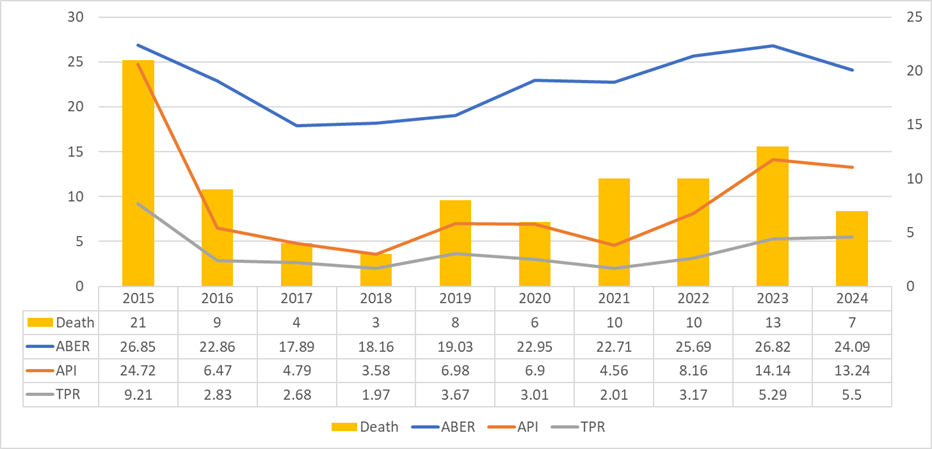
ABER, API & TPR for the last 10 years:
Epidemiological situation of Malaria in Mizoram 2024:
|
Name of District |
Population |
No. of Fever Cases |
No. of RDT Performed |
No. of BSE Performed |
Total Blood Examination |
Total Malaria Cases |
Pv Cases |
Pf Cases |
Total No. of Death |
ABER |
API |
TPR |
TFR |
Pf % |
SPR |
SFR |
|
|
1 |
2 |
3 |
4 |
5 |
6 |
7 |
8 |
9 |
10 |
11 |
12 |
13 |
14 |
16 |
17 |
18 |
|
|
Aizawl East |
282293 |
62967 |
31737 |
31230 |
62967 |
30 |
24 |
6 |
0 |
22.31 |
0.11 |
0.05 |
0.01 |
20.00 |
0.01 |
0.00 |
|
|
Aizawl West |
198128 |
34868 |
19601 |
15267 |
34868 |
41 |
23 |
18 |
0 |
17.60 |
0.21 |
0.12 |
0.05 |
43.90 |
0.12 |
0.05 |
|
|
Lunglei |
174520 |
44918 |
38951 |
5967 |
44918 |
3775 |
1460 |
2315 |
0 |
25.74 |
21.63 |
8.40 |
5.15 |
61.32 |
1.16 |
0.72 |
|
|
Siaha |
69231 |
16371 |
14170 |
2201 |
16371 |
1607 |
1286 |
321 |
0 |
23.65 |
23.21 |
9.82 |
1.96 |
19.98 |
5.68 |
1.09 |
|
|
Kolasib |
93465 |
17845 |
15164 |
2681 |
17845 |
16 |
14 |
2 |
1 |
19.09 |
0.17 |
0.09 |
0.01 |
12.50 |
0.19 |
0.04 |
|
|
Mamit |
101687 |
26295 |
21651 |
4647 |
26298 |
3299 |
1816 |
1483 |
1 |
25.86 |
32.44 |
12.54 |
5.64 |
44.95 |
2.00 |
0.86 |
|
|
Champhai |
145167 |
33737 |
23841 |
9886 |
33727 |
31 |
23 |
8 |
0 |
23.23 |
0.21 |
0.09 |
0.02 |
25.81 |
0.08 |
0.03 |
|
|
Lawngtlai |
142282 |
48552 |
42312 |
6286 |
48598 |
8067 |
3286 |
4781 |
5 |
34.16 |
56.70 |
16.60 |
9.84 |
59.27 |
11.63 |
8.11 |
|
|
Serchhip |
69498 |
21876 |
14653 |
7223 |
21876 |
33 |
17 |
16 |
0 |
31.48 |
0.47 |
0.15 |
0.07 |
48.48 |
0.40 |
0.22 |
|
|
TOTAL |
1276271 |
307429 |
222080 |
85388 |
307468 |
16899 |
7949 |
8950 |
7 |
24.09 |
13.24 |
5.50 |
2.91 |
52.96 |
1.27 |
0.76 |
Action taken to control/eliminate malaria
• IRS: Indoor Residual spray by Deltamethrin done twice a year in SC>1 API.
• Long-lasting insecticidal nets (LLIN) distribution: In 2024, 406947 nos. of Long-lasting Insecticidal nets (LLIN) covering 169 sub centers with a total household of 274257 was saturated with 100% household coverage.
• Bed net impregnation by Insecticide: Bed net impregnation by Deltamethrin have been done twice a year including army, constructions worker camp in non-LLIN coverage area in the districts.
• Early diagnosis and complete treatment: Rapid diagnostic kits and anti-malaria drugs made available in all villages at free of cost.
• Regular and frequent monitoring and supportive supervision have been carried out by state and districts staffs (regular and contractual staffs).
• IEC activities: Several IEC activities, i.e., miking, awareness campaign to NGOs, schools etc, print & electronic media, source reduction drive, observation of anti-malaria month & day have been carried out.
• High endemic districts, i.e., Lunglei, Lawngtlai, Mamit & Siaha, are being operated with NGO partner (ADRA) to reduce malarial incidence.
• Special Malaria Intervention: Intervention activities taken on the high-endemic and hard-to-reach villages, i.e., Vector Control, Mass Survey, IEC/BCC activities to reduce malaria transmission and enhance community awareness.
• State Level Task Force Committee on Malaria Elimination: Formed under the chairmanship of Principal Secretary, Gov’t of Mizoram in 2017 for seeking intersectoral convergence with different line departments under Gov’t of Mizoram. The committee is expected to conduct a quarterly meeting. Last meeting held in March 2022.
• District Level Task Force Committee on Malaria Elimination: Formed under the chairmanship of the Deputy Commissioner of every district in 2017.
OBJECTIVES AND TARGETS OF DENGUE CONTROL PROGRAMME:
OBJECTIVES: Following are the specific objectives of the Mid Term Plan
· To reduce the incidence of Dengue and Chikungunya and to bring down the disease burden.
· To reduce the case fatality rate due to Dengue.
TARGETS:
· Dengue cases fatality rate to below 1%.
· Functional Sentinel Surveillance Hospital in all endemic districts/towns/cities.
· Functional Rapid Diagnostic Response team in all endemic districts/towns/cities.
The prevalence of dengue disease is rising year by year across the State. A significant outbreak occurred in 2022, particularly affecting Aizawl city and Lunglei town, with 1,868 ELISA-confirmed positive cases and 5 deaths reported. In 2024, the number of confirmed positive cases decreased to 744, with 1 death reported.
As part of the mitigation plan to control the dengue outbreak in the State, the SVBDCP aims to accelerate the strategic implementation of various activities, including the dissemination of IEC/BCC materials, entomological surveillance, and the management of diagnostic and other essential equipment supplies.
STATUS OF MIZORAM FOR DENGUE IS AS FOLLOWS:
|
Year |
Suspected Cases |
Positive Cases |
Deaths |
|
2012 |
90 |
6 |
Nil |
|
2013 |
96 |
7 |
Nil |
|
2014 |
246 |
19 |
Nil |
|
2015 |
338 |
43 |
Nil |
|
2016 |
1423 |
580 |
Nil |
|
2017 |
1015 |
136 |
Nil |
|
2018 |
867 |
68 |
Nil |
|
2019 |
853 |
131 |
Nil |
|
2020 |
623 |
67 |
Nil |
|
2021 |
420 |
83 |
Nil |
|
2022 |
5252 |
1868 |
5 |
|
2023 |
12949 |
2060 |
2 |
|
2024 |
9342 |
744 |
1 |
EXECUTIVE SUMMARY
The disease situation in Mizoram State is as below:
|
Year |
Malaria Cases |
Malaria Deaths |
Dengue Cases |
Dengue Deaths |
Chikungunya Cases |
AES/ |
AES/ |
Kala-azar Cases |
Kala-azar Deaths |
Micro-filaria Rate % |
|
2012 |
9883 |
25 |
6 |
Nil |
Nil |
Nil |
Nil |
Nil |
Nil |
Nil |
|
2013 |
11408 |
21 |
7 |
Nil |
Nil |
Nil |
Nil |
Nil |
Nil |
Nil |
|
2014 |
23105 |
31 |
19 |
Nil |
Nil |
Nil |
Nil |
Nil |
Nil |
Nil |
|
2015 |
28593 |
21 |
43 |
Nil |
Nil |
Nil |
Nil |
Nil |
Nil |
Nil |
|
2016 |
7583 |
9 |
580 |
Nil |
Nil |
Nil |
Nil |
Nil |
Nil |
Nil |
|
2017 |
5715 |
4 |
136 |
Nil |
Nil |
Nil |
Nil |
Nil |
Nil |
Nil |
|
2018 |
4296 |
3 |
68 |
Nil |
10 |
Nil |
Nil |
Nil |
Nil |
Nil |
|
2019 |
8543 |
8 |
131 |
Nil |
Nil |
Nil |
Nil |
Nil |
Nil |
Nil |
|
2020 |
8349 |
6 |
67 |
Nil |
Nil |
Nil |
Nil |
Nil |
Nil |
Nil |
|
2021 |
5637 |
10 |
83 |
Nil |
Nil |
Nil |
Nil |
Nil |
Nil |
Nil |
|
2022 |
10229 |
10 |
1868 |
5 |
53 |
1 |
1 |
Nil |
Nil |
Nil |
|
2023 |
18005 |
13 |
2060 |
2 |
44 |
Nil |
Nil |
Nil |
Nil |
Nil |
|
2024 |
16899 |
7 |
744 |
1 |
3 |
Nil |
Nil |
Nil |
Nil |
Nil |
Malaria remains a major public health challenge in the State to date. Confirmed dengue cases continue to rise year by year. Chikungunya was first identified in 2018, with 53 confirmed cases reported in 2022—the highest recorded to date—and 3 cases reported in 2024. Japanese Encephalitis (JE) and Acute Encephalitis Syndrome (AES) were also detected in 2022, with one confirmed positive case. Other vector-borne diseases, such as Kala-azar and Lymphatic filariasis, have not been reported in the State as of 2025